
The Mid-Year FPD Bump – Recovery in Education?

Panasonic Connect Expands Direct-View LED Line with 55-Inch MEVIX Display
October 9, 2026The Mid-Year FPD Bump – Recovery in Education?
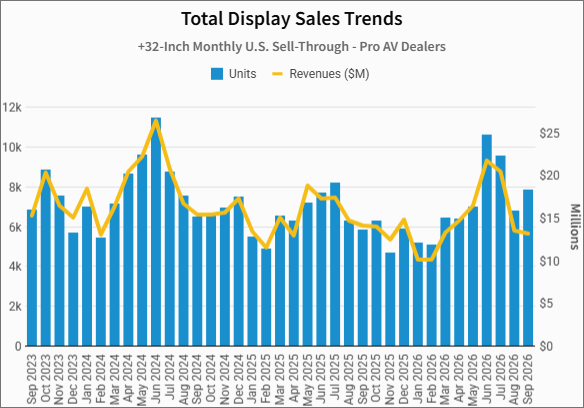
An encouraging trend has developed across the various flat panel display data (FPD) sources available to PMA Research, the syndicated arm of Apogee Insight, Inc. Starting in June, year-over-year trends indicated a large jump in sales of FPD’s through pro AV dealers. This then tapered through August and bumped back up in September. All told this translates into a 24% increase in units volumes and 8% in revenues for the 4-month period this year versus last year.
To be fair, a similar surge was noted in 2024, though with an even earlier, April start. However, comparing sales for the June to September period shows that 2026 is faring a bit better on the unit side, with a 2% increase. Revenues have fallen behind, dropping 13%, highlighting the challenge to pricing that has been a long term story of declines. At least in the current context, falling prices could indicate some relief to tariffs, even if shipping costs may remain elevated due to high fuel prices.
But backing up a step, what is it that might be causing the surge in sales during the late summer months? Historically, those in the know would attribute this to the buying cycle in higher education, a core market for pro AV. With classrooms and campuses empty, the AV/IT managers of the higher ed instutions can actually work on needed technology upgrades in earnest, leading to a normal seasonal increase.
From that perspective, last summer’s more paltry volume increase is the outlier. As is widely known now, this was a direct result of the funding challenges faced by many institutions during an already long-term trend of declining enrollment. Furthermore, after heavy investments in new kit in 2021-2023 as a result of the pandemic, there was going to be a period of reset as the replacement wave reached a normal lull. While the waves abated gradually each year, the low point seems to be 2025.
The result in 2026 is thus a refreshing indication that we may now be seeing the start of the next upgrade and replacement cycle. While not a tsunami yet by any stretch, the data so far is encouraging. Time will tell if it is a real wave tat builds in amplitude or just a temporary blip on the radar. Stay tuned to find out or even better, subscribe to see the underlying brands and technologies that are benefitting most.